

Most people have heard the term "informed consent," but we often associate it with surgery, an invasive procedure, or signing a form before entering a clinical trial. In reality, informed consent is much broader than a signature on a document. It is a fundamental principle of medical care, and it should apply whenever a patient is being asked to accept an intervention that carries potential benefit, potential harm, or meaningful uncertainty.
The American Medical Association describes informed consent as a process in which patients receive the information necessary to make a voluntary and well-considered decision about their care. That includes understanding the nature and purpose of the proposed intervention, its expected benefits, its burdens and risks, reasonable alternatives, and the option of declining treatment. In other words, informed consent is not simply permission to proceed. It is an exchange of information intended to allow the patient to participate intelligently in a decision that ultimately affects their body, their health, and their future.
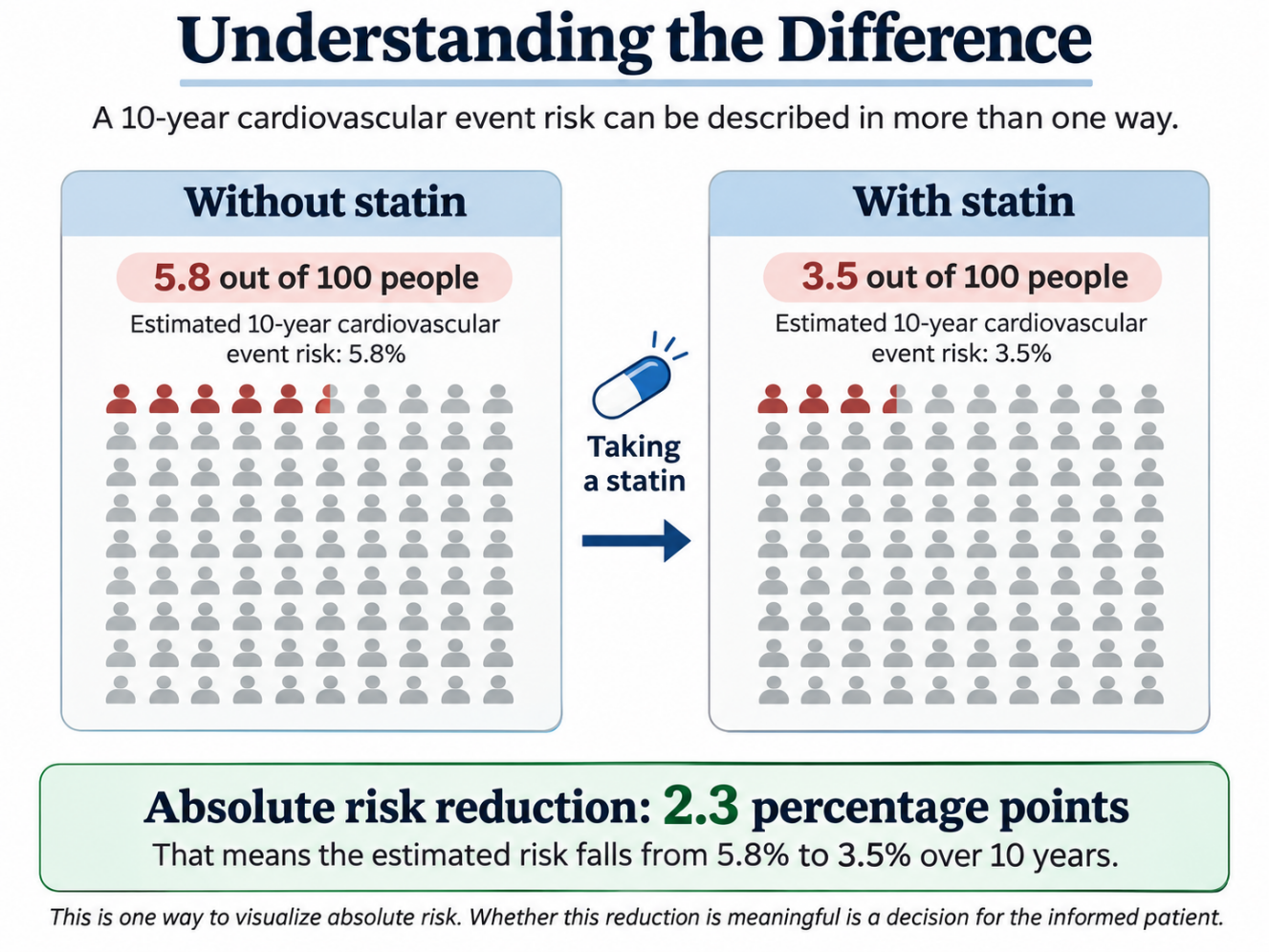
That sounds straightforward, but the quality of informed consent depends heavily on how information is presented. Statin therapy offers a useful example. If you hear that a medication "reduces cardiovascular risk by about 40%," you still need to know what that means for you. In a hypothetical illustration, reducing an estimated 10-year risk from 5.8% to 3.5% would mean an absolute reduction of 2.3 percentage points and a relative reduction of approximately 40%. These are two ways of describing the same change. This illustration is not a trial result or an individualized prediction. Ask for your own starting risk, expected benefit, and the time period involved before deciding what the numbers mean to you.
The same principle applies to potential harms. If the benefit has been explained but the other side of the decision is summarized as "generally well tolerated," you can ask for more detail. What are the important known adverse effects? How common or uncommon are they? What remains uncertain, and what reasonable alternatives exist? Those answers help you decide whether the expected benefit is important enough to accept the accompanying risks, burdens, and uncertainties.
That judgment belongs to you. What is "tolerable" and what is "meaningful" depend on your health, priorities, and preferences. You can ask your clinician to put the evidence into your personal context and explain the tradeoffs. The purpose of informed consent is not to produce the same answer from every patient. It is to understand the decision well enough to make your own.
Statin therapy provides a particularly useful example because these medications are widely prescribed, their cardiovascular benefits are established in some populations, and there continues to be considerable public discussion about both their benefits and their potential adverse effects. They also illustrate why the same medication can represent a very different decision depending on whether it is being prescribed to someone with established cardiovascular disease or to an otherwise asymptomatic person considering treatment for primary prevention.
The larger subject of this article is therefore not statins. It is informed consent.
Prevention changes the conversation
Prevention presents a unique decision when you feel well: accepting an intervention today to reduce the probability of something happening years into the future. In this situation, treatment addresses future risk rather than an event that has already occurred. That does not diminish the value of prevention. It makes your starting risk and expected absolute benefit especially important questions to ask.
Statins can reduce cardiovascular events. For a person who has already suffered a myocardial infarction, has established coronary artery disease, peripheral arterial disease, or another manifestation of atherosclerotic cardiovascular disease, the potential absolute risk reduction has been shown to be greater than when used for primary prevention risk reduction.
Primary prevention is different. These are people who have not experienced an atherosclerotic cardiovascular event, and their baseline risk varies enormously. Because absolute benefit depends heavily on the starting risk, the absolute risk reduction is smaller than in a population with known disease.
That distinction is often obscured by the way medical risk is communicated to the patient.
Relative risk can sound very different from absolute risk
Consider the HOPE-3 trial, which studied people without established cardiovascular disease who were considered at intermediate cardiovascular risk. Over a median of 5.6 years, cardiovascular death, nonfatal myocardial infarction, or nonfatal stroke occurred in 4.8% of participants receiving placebo and 3.7% receiving rosuvastatin. The reported hazard ratio was 0.76, approximately a 24% reduction in cardiovascular hazard. Expressed as the difference in observed event proportions, the absolute reduction was 1.1 percentage points, with approximately 91 people needing treatment for the duration of the trial to prevent one such event. Read the source.
These descriptions communicate different aspects of the result. Neither needs to be minimized or promoted. You can ask for both the relative effect and the absolute difference, with the same outcome and follow-up period clearly identified.
Now compare that general concept with secondary prevention, or treatment for those with known cardiac disease, where baseline cardiovascular risk is considerably higher. In the 4S or Scandinavian Simvastatin Survival Study, patients already had coronary heart disease. Major coronary events occurred in approximately 28% of the placebo group and 19% of the simvastatin group over about 5.4 years, an absolute difference of approximately 9 percentage points. Read the source.
HOPE-3 and 4S are not directly comparable trials. They involved different populations, different eras, different drugs, and different outcomes. But they illustrate an important principle: when baseline risk is high, the potential absolute benefit from treatment can be dramatically larger.
That is why a person who has already experienced a myocardial infarction is having a fundamentally different conversation from someone whose estimated 10-year primary-prevention risk is 5% or 6%.
The evidence for statins in primary prevention exists. The question is not whether statins can reduce cardiovascular events in this population. The question for the individual patient is, "How large is my expected absolute benefit, and what am I willing to accept to obtain it?"
Only you can decide whether the expected benefit is meaningful to you.
The other side of the informed-consent equation
Once you understand the expected absolute cardiovascular benefit, ask about the best available information on potential harms as well. This does not mean building a case against the medication. It means completing your decision.
Some potential statin effects are supported by strong randomized evidence. Others are uncommon but clearly recognized. Still others remain uncertain and are being actively investigated. Those distinctions matter, and an informed-consent conversation should make them clear rather than placing every possible adverse effect into the same category.
Statins and skeletal muscle effects
The relationship between statins and skeletal muscle has been recognized for decades. If muscle symptoms, a physically demanding routine, or a previous reaction are concerns for you, ask how they will be assessed and whether a creatine kinase, or CK, test is appropriate in your situation. CK is a blood marker of muscle breakdown.
CK is an enzyme found in skeletal muscle and other tissues. When the integrity of muscle cells is disturbed, CK can leak into the bloodstream. Exercise can raise CK, sometimes substantially, so an elevated CK value does not automatically mean pathological muscle damage. Statins can cause muscle injury, which can range from mild to significant. In the observational PRIMO study, people taking high-dose statins who regularly exercised vigorously reported muscle symptoms more often than those who did leisure-time activity. The study did not establish that exercise increased muscle tissue breakdown.
Statin-associated muscle effects exist on a spectrum, from pain, soreness, weakness, and cramping to clinically significant myopathy and, much less commonly, rhabdomyolysis. Muscle symptoms often occur without a marked CK elevation. Substantial CK elevations and severe muscle injury are uncommon. Risk can vary with the statin, dose, interacting medications, and individual circumstances. Read the source.
For your decision, that distinction matters. You do not need to assume that statins routinely cause serious muscle damage, and you do not need to dismiss new symptoms because most people tolerate treatment.
If you develop new weakness, fatigue, soreness, cramping, or an unexplained decline in physical function after starting therapy, report the change and ask for an evaluation. Your symptoms, exercise, other medications, and timing all deserve consideration. Discuss any treatment changes with your prescribing clinician.
Statins and the risk of new-onset type 2 diabetes
The relationship between statins and diabetes is clearer because the evidence comes from large randomized trials.
A 2024 individual-participant meta-analysis from the Cholesterol Treatment Trialists' Collaboration examined more than 150,000 participants in blinded randomized trials. Compared with placebo, low- or moderate-intensity statin therapy increased new-onset diabetes by approximately 10% relatively, while high-intensity therapy increased new-onset diabetes by approximately 36% relatively. Read the source.
Absolute numbers matter here too. Among the low- and moderate-intensity trials included in that analysis, diabetes occurred at approximately 1.3% per year among statin participants compared with 1.2% per year among placebo participants. In the high-intensity trials, the observed rates were approximately 4.8% per year versus 3.5% per year, although the authors cautioned that differences in glucose and HbA1c surveillance between trials affected the absolute diagnosis rates.
The metabolic profile of the patient also mattered. Much of the excess diabetes occurred among participants whose baseline glycemia was already closest to the diagnostic threshold. That observation is clinically important because risk is not distributed evenly throughout any population.
A small deterioration in glucose regulation may have little immediate consequence for someone with excellent glycemic control. For a person with elevated fasting glucose, increasing HbA1c, central adiposity, elevated triglycerides, low HDL cholesterol, or other evidence of metabolic dysfunction, the same physiologic change may be considerably more important.
Again, the appropriate conclusion is not that statins inevitably cause diabetes or that diabetes risk eliminates their cardiovascular benefit. The appropriate conclusion is that the risk exists, it is supported by randomized evidence, it appears to be influenced by treatment intensity and baseline metabolic status, and patients deserve to know about it.
You can weigh that information alongside your expected cardiovascular benefit and ask how your own metabolic health affects the balance.
Statins and dementia
This part of the conversation is particularly sensitive because cognitive decline carries a different kind of fear for many people. A myocardial infarction is frightening, but the possibility of losing memory, judgment, independence, recognition of family members, and eventually the ability to care for oneself creates a different emotional response.
Concerns about statins and cognition are not new. Product labeling describes rare postmarketing reports of memory loss, forgetfulness, or confusion.
A newly published 2026 study in Frontiers in Pharmacology adds a different type of evidence to that discussion. Researchers examined statin exposure and incident dementia in two large independent populations: the U.S. All of Us Research Program and the UK Biobank. Read the source.
In the All of Us cohort, dementia occurred at a rate of 64.9 cases per 10,000 person-years among statin users compared with 30.7 among non-users, a difference of 34.2 cases per 10,000 person-years. In the UK Biobank replication cohort, the corresponding rates were 11.8 versus 6.2 per 10,000 person-years. Statin use was associated with a higher dementia hazard in both cohorts. These are observational group rates, not your personal 10-year risk or proof of harm caused by the medication.
The investigators also observed an intensity relationship. In the All of Us cohort, dementia occurred at a rate of 59.0 cases per 10,000 person-years among people taking moderate-to-low intensity statins and 84.6 cases per 10,000 person-years among those taking high-intensity statins. That is an absolute difference of 25.6 cases per 10,000 person-years between the two treatment-intensity groups. After adjustment for measured differences between participants, high-intensity therapy was associated with a 14% higher dementia hazard than moderate-to-low intensity therapy.
Those findings deserve attention, but they do not establish causation. This was an observational study, and the people prescribed statins were substantially different from those who were not. Before statistical weighting, statin users had much more hypertension, diabetes, obesity, coronary artery disease, and other conditions that could themselves influence dementia risk. The researchers used statistical methods to make the statin and non-statin groups more comparable, and the association remained when they tested the data in several different ways.
The authors openly acknowledge this limitation and specifically identify residual confounding and confounding by indication as possible explanations for at least part of the association.
What can you take from this uncertainty? The study does not prove that statins cause dementia. It gives you a reason to ask how observational findings fit with other evidence. In the randomized PROSPER study, cognitive testing of 5,804 participants over an average of 42 months found no difference in cognitive decline between pravastatin and placebo. That finding does not settle every question about lifetime dementia risk, but it is an important part of the evidence to consider alongside an observational association. Read the source.
Questions you can bring to the conversation
Return to the hypothetical example: an estimated 10-year cardiovascular event risk falling from 5.8% to 3.5%. That is an absolute reduction of 2.3 percentage points and approximately 40% relative. It is an illustration of risk communication, not a prediction of what a statin will do for you. Before making your own decision, ask what estimate applies to your situation and how certain it is.
Then ask about the relevant risks and uncertainties, including muscle symptoms, the established increase in new-onset type 2 diabetes, and what the evidence does and does not show about cognition. Ask how long you would take the medication and how benefit, symptoms, and changing health will be reviewed. None of these risks should be treated as inevitable. They matter because they may affect how you value the potential benefit.
Your cardiovascular risk is influenced by far more than LDL cholesterol. Blood pressure, smoking, cardiorespiratory fitness, nutrition, insulin resistance, body composition, and sleep all contribute to your long-term health trajectory. Successfully addressing these factors through sustained lifestyle changes can substantially reduce cardiovascular risk and, for some individuals, may provide greater overall benefit than lowering LDL-C with a statin alone.
This does not mean statins have no value. It means the decision should consider your overall cardiovascular health, the magnitude of benefit you might reasonably expect from medication, and what can be achieved through lifestyle improvement.
There is another important question worth asking: Do you already have evidence of coronary artery disease? In appropriately selected patients without known cardiovascular disease, a coronary artery calcium (CAC) scan can help answer that question by identifying calcified coronary plaque. A score of zero may support a decision to defer medication in some circumstances, while a higher score can strengthen the case for treatment.
Rather than making a lifelong medication decision based primarily on cholesterol levels or a risk estimate, consider whether a more complete assessment could help you and your clinician make a better-informed choice.
Read The $100 Question: Coronary Artery Calcium to learn how a relatively inexpensive test can add meaningful information to that conversation.
Perhaps you are more concerned about your family history of diabetes as everyone in your family that died or had a coronary event had diabetes initially. This situation may matter to you.
With that broader picture, you are better equipped to decide whether the expected benefit is meaningful enough to you to accept the risks, burdens, and uncertainties of treatment.
One person may say yes. Another may say no. A third may want more information before deciding. The purpose of informed consent is not to produce the same answer from everyone. It is to help you understand your options and make a voluntary, well-considered decision with your clinician.
Informed means informed
This is ultimately the point.
You need more than an explanation of why a treatment may help. You also need understandable information about potential harms, uncertainty, alternatives, and the size of the expected benefit.
These questions are worth asking even if you are perfectly comfortable taking medication. They can become increasingly important as one prescription is added to another over time.
Polypharmacy introduces risks that are not always obvious when each medication is considered individually. Drug interactions, overlapping adverse effects, changes in how medications are metabolized, and the cumulative burden of treatment can all become clinically important. Many individual medications have been studied extensively, but the exact combinations that patients ultimately take in everyday practice are often supported by much less direct evidence than the drugs themselves.
You should not have to become a medical expert to participate in your care. But you can arrive with questions, ask for plain-language answers, and say when an explanation is not yet clear enough for you to make a decision.
If a visit feels rushed, ask for a written explanation or a follow-up conversation before making a nonurgent decision. Bring someone you trust if that helps you listen, take notes, and compare the options.
You do not need a list of every remotely possible adverse event. Start with the questions that make the decision understandable:
- What is my risk without treatment?
- What is the expected absolute benefit, over what period?
- What are the important harms and uncertainties?
- What are my alternatives, including declining treatment?
- How will we review the decision?
Asking these questions is not being difficult. It is exercising agency in your own care. You can be respectful, direct, and persistent until you understand the recommendation and the choices available to you.
The goal of informed consent is not agreement. It is understanding.
You have a role in your healthcare decisions. Asking for the information you need is part of that role. You do not have to wait for a different healthcare system to begin taking a more active part in the conversation.
Without that conversation, consent may have been obtained. But it is difficult to call it fully informed.
References
- American Medical Association. Code of Medical Ethics, Opinion 2.1.1: Informed Consent.
- Yusuf S et al. Cholesterol Lowering in Intermediate-Risk Persons without Cardiovascular Disease. HOPE-3. New England Journal of Medicine. 2016.
- Scandinavian Simvastatin Survival Study Group. Randomised trial of cholesterol lowering in 4,444 patients with coronary heart disease: the 4S study. Lancet. 1994.
- Stroes ES et al. Statin-associated muscle symptoms: European Atherosclerosis Society Consensus Panel Statement. European Heart Journal. 2015.
- Bruckert E, Hayem G, Dejager S, Yau C, Bégaud B. Mild to moderate muscular symptoms with high-dosage statin therapy in hyperlipidemic patients: the PRIMO study. Cardiovascular Drugs and Therapy. 2005;19(6):403–414.
- Cholesterol Treatment Trialists’ Collaboration. Effects of statin therapy on new-onset diabetes and worsening glycaemia in large-scale randomised blinded statin trials: an individual participant data meta-analysis. Lancet Diabetes & Endocrinology. 2024.
- U.S. Food and Drug Administration. CRESTOR prescribing information, section 6.2, Postmarketing Experience. 2024.
- Lee DH et al. Association between statin therapy and dementia risk: evidence from All of Us and UK Biobank with coenzyme Q7-related mediation analysis. Frontiers in Pharmacology. 2026.
- Trompet S et al. Pravastatin and cognitive function in the elderly. Results of the PROSPER study. Journal of Neurology. 2010.
Educational information, not an individualized treatment recommendation. Discuss medication decisions and new symptoms with your prescribing clinician.

